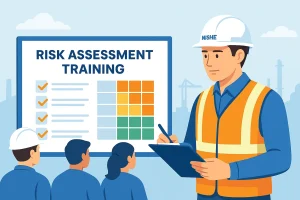
Risk Assessment Training – 1-Day Practical Workshop
Learn how to identify hazards, evaluate risks and implement effective control measures in your workplace.
This intensive Risk Assessment Training is aligned with health and safety legislation and helps strengthen
your organisation’s safety culture.
Ideal for Health and Safety Officers, supervisors, managers and safety committee members who want a solid,
hands-on understanding of risk assessment.
1 Day · 8 Hours
Classroom / Live Online
Beginner–Intermediate
NISHE Certificate
Course Overview & Objective
This Risk Assessment Training course equips participants with the knowledge and practical tools required
to carry out effective, documented risk assessments in line with workplace health and safety regulations
and best practice.
By the end of the workshop, learners will be able to recognise workplace hazards, estimate and evaluate
levels of risk, decide on suitable control measures and contribute to continuous improvement in their
organisation’s Health and Safety Management System.
 Who Should Attend?
- Health and Safety / HSE Officers and Executives
- Supervisors, engineers, section heads and managers
- Members of safety committees and HSE co-ordinators
- Any personnel responsible for workplace safety or compliance
Manufacturing
Oil & Gas
Facilities
Healthcare
Quick Facts
HAZOP, FMEA, JSA, review and continual improvement.
Templates
Interactive
Course Curriculum – Risk Assessment Training (1 Day)
Participants move from basic definitions to advanced techniques, with examples from construction,
manufacturing and healthcare.
Module 1 – Introduction & Legislative Framework
- Hazard, risk and risk assessment – key definitions
- Importance of risk assessment for accident prevention
- Overview of relevant health and safety legislation & standards
For general legal guidance you can also refer to
official HSE risk assessment advice
.
Module 2 – Stages of Risk Assessment
- Identifying hazards – inspections, reports, MSDS, HSE guidance
- Profiling risks – who can be harmed, likelihood and severity
- Evaluating risks – qualitative & quantitative scoring and ranking
- Controlling risks – applying the hierarchy of controls
Module 3 – Risk Assessment Methodologies
- Qualitative methods – brainstorming, checklists, Delphi
- Quantitative overview – fault tree and event tree analysis
- Semi-quantitative – risk matrices and semi-numeric scoring
Module 4 – Specific Techniques (HAZOP, FMEA, JSA)
- HAZOP – objectives, team roles and methodology
- FMEA – failure modes, effects and criticality
- Job Safety Analysis – job steps, hazards and safe methods
Module 5 – Implementing Risk Assessment in the Workplace
- Planning and preparation – roles, scope and timetable
- Conducting the assessment – walk-through, consultation & documentation
- Communicating findings and driving actions
- Reviewing and updating risk assessments
Module 6 – Case Studies & Practical Exercises
- Manufacturing: machines, ergonomics, noise, chemicals
- Construction: working at height, lifting, vehicles, excavation
- Healthcare: biological risks, sharps, slips/trips, patient handling
- Group work using sample risk assessment templates
Module 7 – Tools, Templates & Digital Resources
- Standard risk assessment templates and checklists
- Overview of risk assessment software and digital tools
- Link with ISO 45001 / OHSMS & documentation
Training Methodology
The Risk Assessment Training uses interactive methods so that participants can immediately apply concepts to their own workplace.
- Classroom / Live Online Sessions: Trainer-led explanations and discussions.
- Relevant Videos: Visual examples of hazards, near misses and controls.
- Group Discussions: Sharing experience from different industries.
- Role Plays & Presentations: Presenting risk assessment findings to management.
- Practical Demonstrations: Hands-on practice using templates and risk matrices.
Case Studies & Practice
Real-life scenarios connect theory with the incidents that actually occur on sites and plants.
- Manufacturing: Machine guarding, ergonomics, noise, chemicals.
- Construction: Working at height, scaffolds, lifting, site traffic.
- Healthcare: Biological agents, sharps, slips/trips, patient handling.
- Practical Exercises: Completing and presenting sample risk assessments.
Evaluation, Certification & Organisational Benefits
- Participants are evaluated through class participation, case studies, group work and role plays.
- Successful learners receive a Certificate of Successful Completion – Risk Assessment Training issued by NISHE.
- Organisations gain better quality and consistency in risk assessments, improved compliance, reduced incidents and a stronger base for ISO 45001 / OHSMS.
Enrol individual learners directly through this course page or contact NISHE for a customised in-house Risk Assessment Training program for your site or project.
Course Features
- Lectures 26
- Quiz 1
- Duration Lifetime access
- Skill level All levels
- Language English
- Students 931
- Certificate Yes
- Assessments Self
- 7 Sections
- 26 Lessons
- Lifetime
- Module 1 – Introduction & Legislative FrameworkHazard, risk and risk assessment – key definitions Importance of risk assessment for accident prevention Overview of relevant health and safety legislation & standards1
- Module 2 – Stages of Risk AssessmentIdentifying hazards – inspections, reports, MSDS, HSE guidance Profiling risks – who can be harmed, likelihood and severity Evaluating risks – qualitative & quantitative scoring and ranking Controlling risks – applying the hierarchy of controls9
- Specific Risk Assessment TechniquesQualitative methods – brainstorming, checklists, Delphi Quantitative overview – fault tree and event tree analysis Semi-quantitative – risk matrices and semi-numeric scoring5
- Implementing Risk Assessment in the Workplace4
- Case Studies and Practical Applications4
- Tools and Resources3
- Exam and Certification1